Lecture 4
- Welcome!
- Artificial Intelligence
- Game Playing
- Decision Trees
- Minimax
- Depth Limited Search
- Evaluation Functions
- Machine Learning
- Reinforcement Learning
- Exploring and Exploiting
- Neural Networks
- Training Neural Networks
- Natural Language Processing
- Word Embeddings
- Attention and Transformers
- Summing Up
Welcome!
- In our previous session, we explored Python programming, learning about variables, types, conditionals, loops, functions, and libraries.
- This week, we explore the fundamentals of artificial intelligence, the ideas, strategies, and algorithms that computer scientists have developed to build intelligent capabilities into computers.
- The goal is to help you understand what artificial intelligence really is, how it works, what it is good at, and what its limitations are.
- By the end of today’s lecture, you will have a solid understanding of the key algorithms and ideas behind modern AI systems.
Artificial Intelligence
- What can we accomplish with artificial intelligence? There are a wide variety of different use cases.
- One of the earliest areas where computer scientists explored AI was in the world of game playing, being able to train a computer to play a game well, whether it’s a simple game like tic-tac-toe or more complex games like chess or Go.
- Other instances where AI has started to show up in our everyday lives include handwriting recognition, where computers are increasingly able to identify what you have written down if you write a digit or a letter.
- Computers are also good at categorizing data. For example, your email inbox. Your computer is automatically classifying some of those emails as spam and others as not spam. The computer needs to have some process to understand which emails to classify as spam.
- Other potential use cases include recommendation systems. When you’re listening to music online or watching videos or movies, a streaming service might recommend videos that it thinks you might enjoy. There needs to be some intelligence for figuring out how to recommend something to you that you’re really going to like.
- Other use cases include text generation, with all sorts of large language models that are available now. We can provide some prompt, some input into a language model, something like “give me a three-day itinerary for a trip to Boston,” and expect that the computer is going to generate an intelligent reply.
Game Playing
- Let’s begin with game playing, one of the earliest places where computer science research in artificial intelligence began.
- Games offer a bit of a simplified environment to start. Rather than deal with the complexities of the real world where there is so much uncertainty and variables, games offer a place where there is usually a very fixed set of rules, very clear constraints that are easy for computers to work with.
-
Consider this breakout-style video game where you’re trying to bounce this ball to hit these objects at the top of the screen:
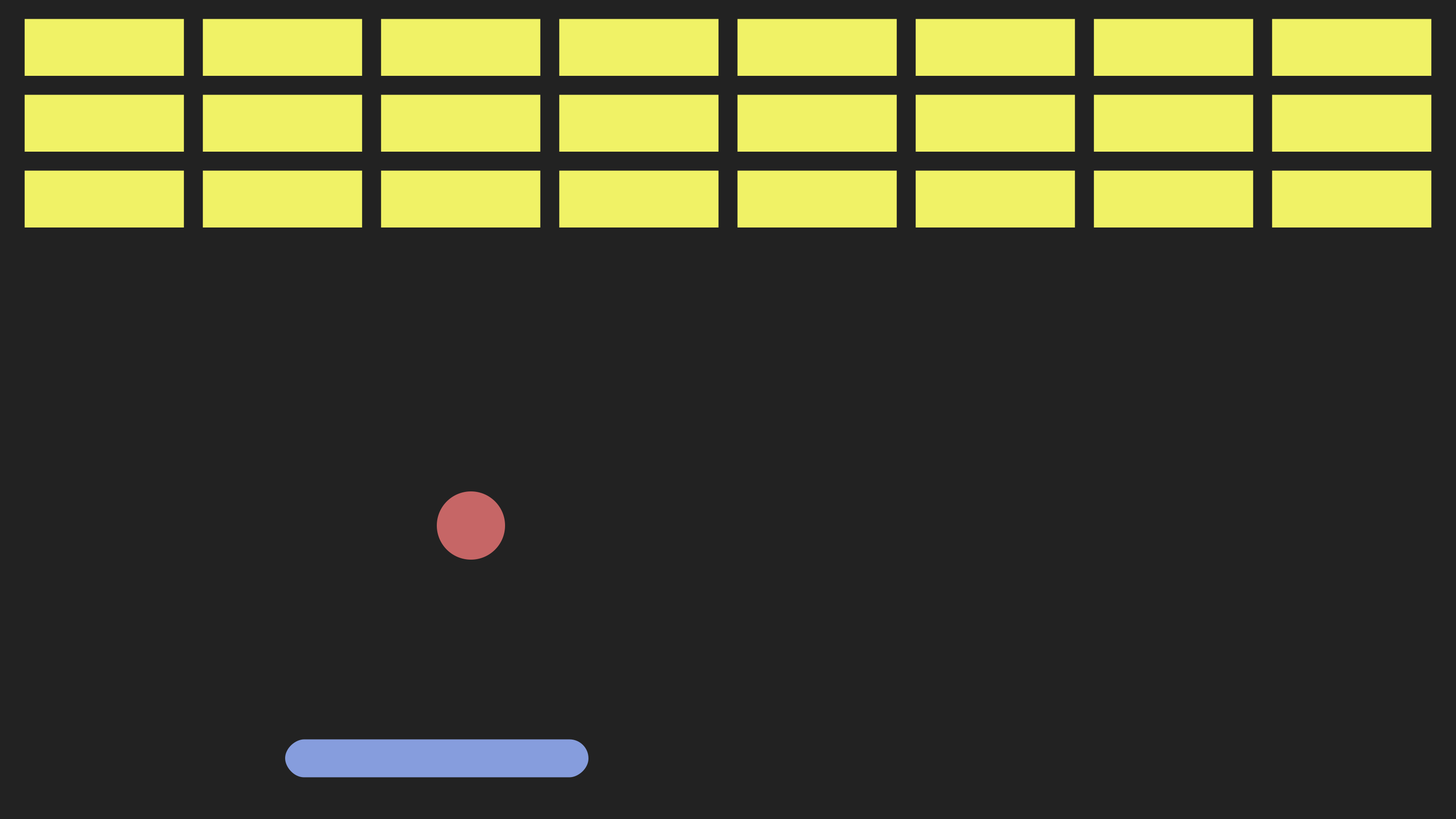
- What would it take to program a computer to play this game well? The computer is going to take some action in response to things happening in the game.
- Imagine what would happen if the ball moved to the left. What action do we want the computer to take? We want the computer to move the paddle to the left in order to catch the ball, to make sure we can bounce it and it doesn’t fall to the bottom of the screen.
Decision Trees
- We could try imagining encoding that information in a structure that allows us to make decisions by asking questions and telling the computer to make decisions based on the answers to those questions.
- To get the paddle to move to the left, we might start by asking a question: is the ball to the left of the paddle?
- Depending on whether the answer is yes or no, we might make a decision about what to do next. If the answer is yes, then we should move the paddle to the left.
- If the answer is no, we might ask a follow-up question: is the ball to the right of the paddle? If yes, we should move the paddle to the right. If no, then we don’t need to move the paddle at all.
- The advantage of structuring our decision-making process like this, asking questions and making decisions based on the answers, is that we can relatively easily convert this idea to code.
-
The pseudocode might look a little something like this:
while game is ongoing
    if ball is to the left of paddle
        move paddle to the left
    else if ball is to the right of paddle
        move paddle to the right
    else
        don't move paddle
Notice the step-by-step process: while the game is ongoing, we repeat the decision process again and again.
Minimax
- Let’s take a different game now, the game of tic-tac-toe (or noughts and crosses, depending on where you’re from).
- The idea of tic-tac-toe is that there are two players, X and O. X and O take turns, placing Xs and Os in one of the nine cells of a three-by-three grid. The goal for each player is to get three in a row, either vertically, horizontally, or diagonally.
- Imagine we are playing as X. If on our turn there is a way to get three in a row, then we should make that move and win. But what if we cannot win immediately? If we’re being careful, we might notice that O is close to getting three in a row themselves. We should block them.
- We might ask: can X win on this move? If yes, play in the spot that lets us get three Xs in a row. If that’s not true, can O win on their next move? If yes, play in the spot that blocks them.
- But what if neither is true? Now it gets more complicated. It might not be immediately obvious what the right decision is. A lot of what artificial intelligence is all about is not just us telling the computer exactly what to do, but giving the computer the tools it needs to figure out on its own what the right decision is.
- The algorithm we’re going to use for game playing is called Minimax. How does Minimax work? Computers ultimately represent things in terms of numbers. If we want a computer to play a game well, we need to take this concept of a game and turn it into numbers.
- As far as the computer is concerned, there are only three outcomes of tic-tac-toe that we really care about: O wins the game, the game is a tie, or X wins the game.
-
We assign a number to each outcome. O winning has a value of negative one. X winning has a value of positive one. A tie has a value of zero.
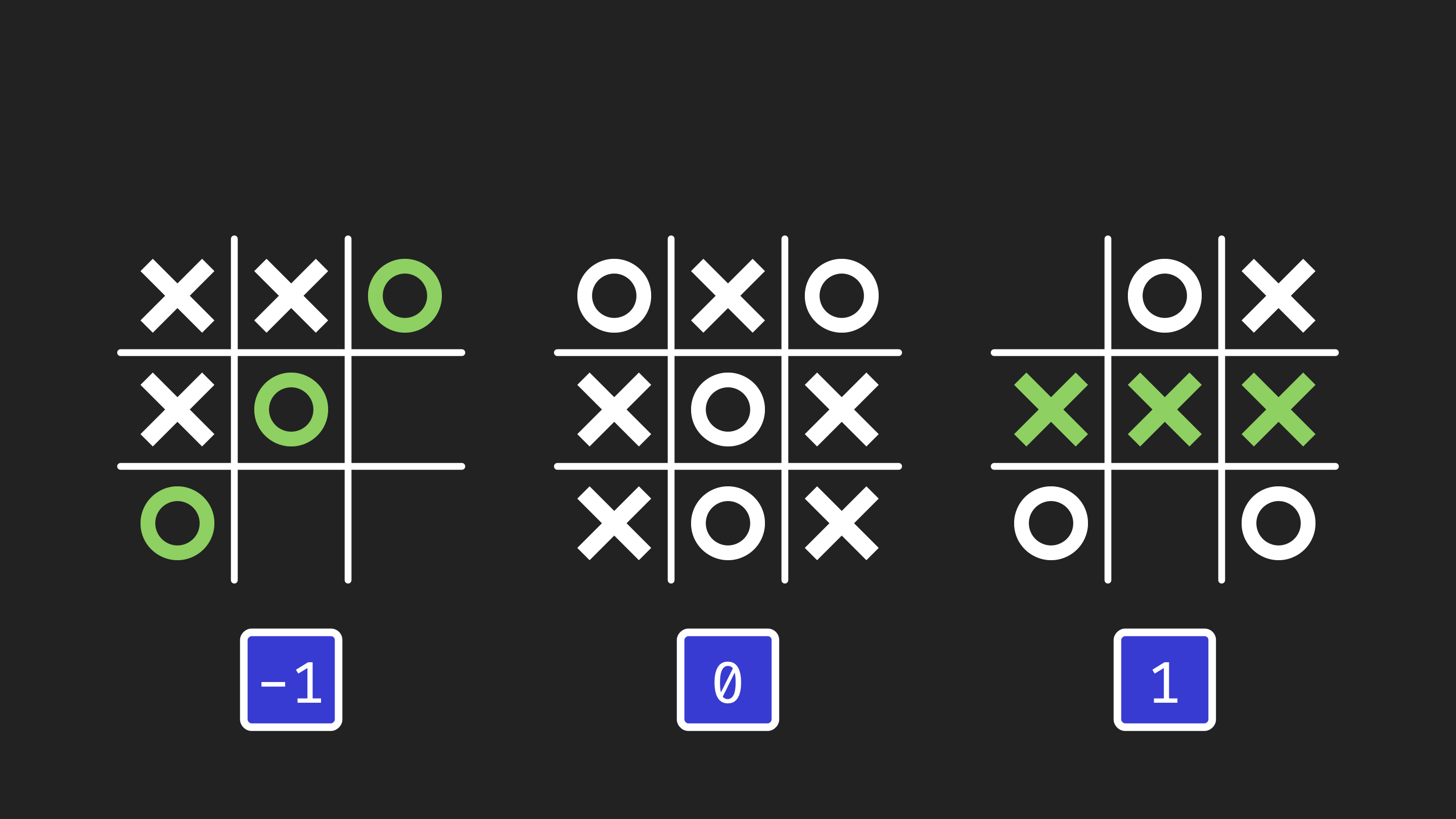
- Once we put numbers to each of these possible outcomes, we can define what the goal for each player is.
- The X player, who we call the max player (the maximizing player), their goal is to maximize the value of the game. They want the value to be as high as possible. One would be best, meaning X wins. Zero, a tie, is still better than negative one.
- The O player, who we call the min player (the minimizing player), their goal is to minimize the game value. They want negative one, meaning O wins. If that’s not possible, tying is still better than X winning.
- Let’s imagine how we could use these values to evaluate what moves to make. Here is a game board that is not yet over. Let’s say it’s O’s turn.
- We want to figure out: if both players are playing optimally, making the best decisions at any given point, what will the value of the game ultimately end up being?
- O has two options. Minimax will consider both of those options because we need to consider all possible moves to decide which is best.
-
For each option, we explore what will happen. If one option leads to X winning (value 1) and another leads to a tie (value 0), the O player, being the minimizing player, will choose the option with the lower value: the tie.
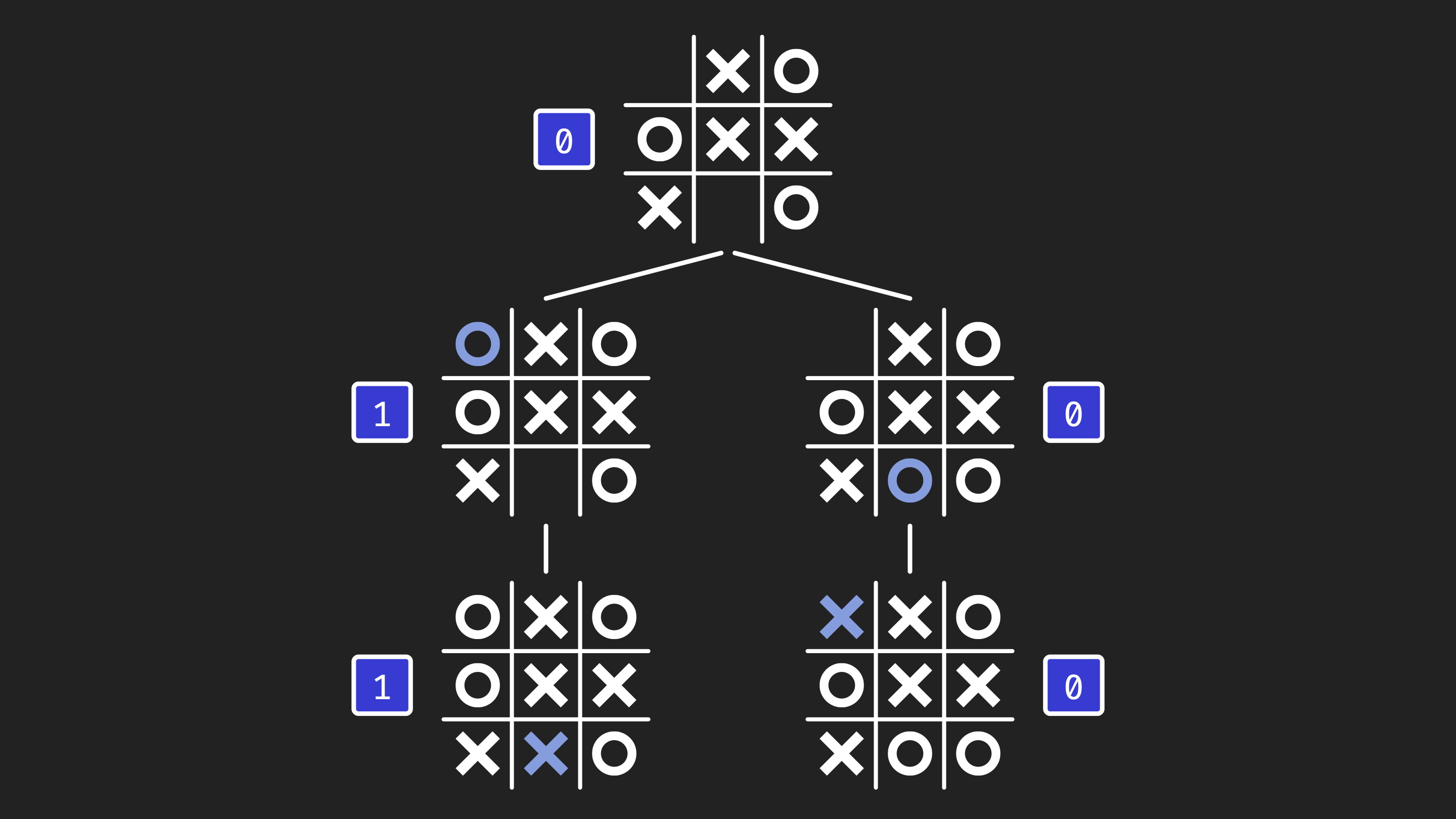
- The algorithm considers all possible moves and responses to determine the optimal play.
- This game state also has a value of zero, meaning if both players play optimally, the game will end in a tie.
- We did this for a position that was two moves from the end, but you could do this at any point in the game. Always consider what all your possible moves are. For each move, what is your opponent’s best response? For each of those, what is your best response? And so on, calculating all the possible ways the game could go, then making a decision based on which has the highest or lowest value.
Depth Limited Search
- This Minimax algorithm can be used to optimally play tic-tac-toe. If you use this algorithm, you will never lose a game of tic-tac-toe.
- But what if we tried to apply this to other games? Tic-tac-toe is relatively simple. Imagine a much more complex game like chess, where there are more pieces, more squares, more possibilities.
- Could you use Minimax for chess? In theory, yes. But in practice, the challenge is there are just so many more possibilities for how a game of chess can go that it’s difficult to calculate all of them.
- For just the first move in tic-tac-toe, there are nine choices (nine squares). In chess, there are 20 different options for the first move.
- After two turns in tic-tac-toe, that’s 9 times 8, giving us 72 possibilities. In chess, 20 times 20 gives us 400 possibilities after just two turns.
- Those possibilities compound exponentially. After nine turns, the game of tic-tac-toe is over with about 260,000 possibilities. In chess, we’re looking at something like 2.4 trillion possibilities with many more turns to play.
- 260,000 possibilities, a fast computer can get through in a matter of seconds. Whereas in chess, even with all the time in the world, it’s not enough to explore every possible game.
-
One possible choice is to take a depth-limited approach. Don’t explore the entire chess game to the end. Only look a certain number of turns ahead, maybe five or six or seven turns, for example.
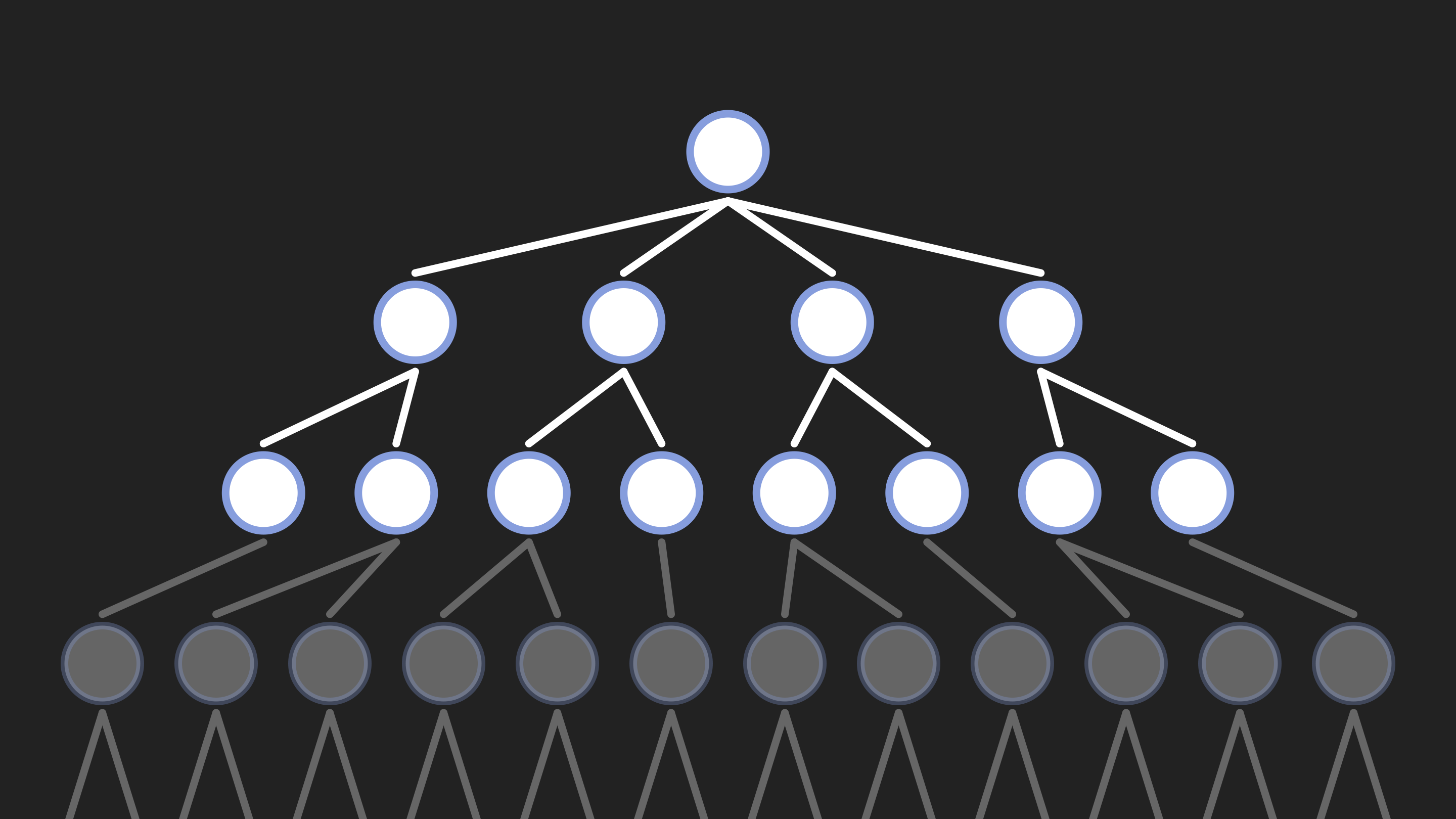
- Only a portion of the tree is explored, with gray nodes representing unexplored possibilities.
- This allows us to limit the number of possibilities we need to explore.
- In artificial intelligence, often even though we could find the best solution by trying all possibilities, we need to consider not just making a good decision, but making a good decision efficiently in a way that we’re actually able to have enough time to make that decision.
Evaluation Functions
- What do we need to change about this algorithm when using a depth-limited approach?
- Before, when we played tic-tac-toe to the end, we could evaluate who won and assign a value. In chess, if we’re only looking a certain number of turns ahead, we might not have reached the end of the game. We don’t yet know who will win.
- We need to make some prediction as to what we think the state of the game is going to be, who we think the winner will end up being, whether the white player or black player is doing better.
- Often what we use for that is something called an evaluation function.
- A function in computer science is something that can take in some data as input, process that input, and produce something as output. Our evaluation function is going to take a state of the game as input and output a prediction for what we think the value of that game is going to be.
- There are different approaches for constructing that evaluation function. Maybe you look at how many pieces the white player has versus how many pieces the black player has. Maybe you look at the positions of those pieces.
- There are also ways that we might be able to train a computer to estimate what we think the evaluation of a particular game state is.
- This is going to help us make a decision as to which of these states we think is better than others, allowing us to decide what the right move is.
Machine Learning
- This might be similar to how you might imagine learning to play a game: if given the rules, you could sit down and figure out your strategy.
- But another way that we get good at things is by learning. You try something, you experience it, and from that experience, you learn. If you do something well, you learn to do more of that in the future. If you do something poorly, you learn to do less of that and learn from your mistakes.
- One idea is to encode that same possibility for computers as well, to allow computers to learn from experience.
- The idea of computers learning is this general area called machine learning.
Reinforcement Learning
- More specifically, what we’re interested in here is a form of machine learning called reinforcement learning.
- Reinforcement learning is all about computers learning from experience. You start with a computer that’s not good at performing some task, and through experience, the computer gets better at performing that task.
- Imagine we have a grid, a maze that we want a computer to navigate. Some cells are walls we don’t want the computer to crash into. We have this computerized AI agent down here trying to get to a goal over there.
- Imagine initially our agent doesn’t know how to navigate. It doesn’t know where the walls are. It doesn’t know what action to take depending on what square it’s in. But it needs to find its way to the goal.
- If it starts with no knowledge, the best it can do is try something at random. Maybe we try to go right and crash into a wall. That didn’t turn out well.
-
We go back to the beginning, but we can learn from that experience. The computer learns that next time in this state, you shouldn’t go right, because it didn’t work out last time.
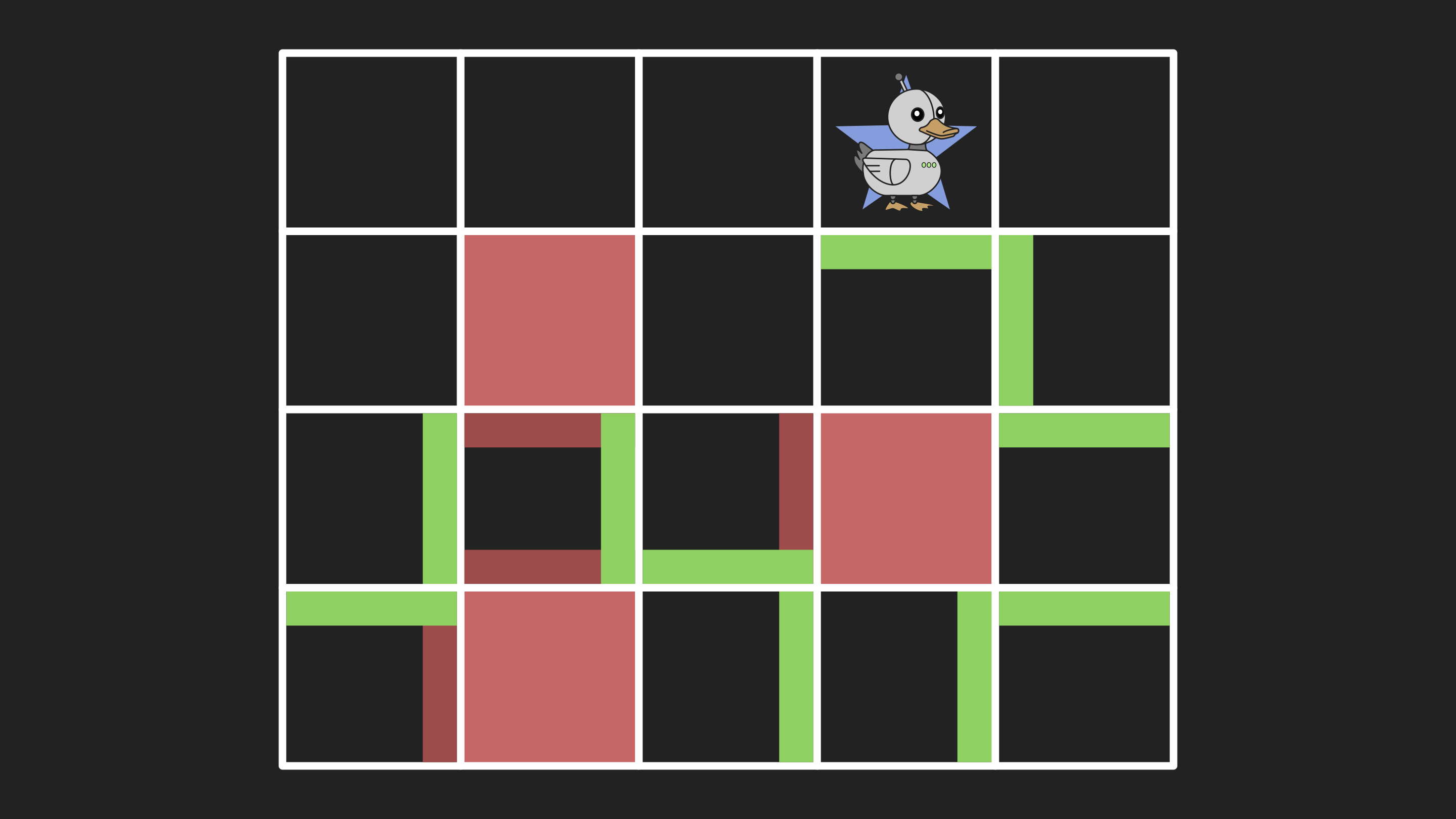
- The agent learns the path through trial and error.
- Next time, we learn to try something different. We’re in a new state we haven’t experienced before. We might try something at random. Maybe we crash into another wall. Now we’ve learned from that too.
- We repeat that process through trial and error. Every time we fail, we learn from that experience. We learn not to do that again.
- Eventually, our agent might find a way to navigate the grid and reach the goal. Once we’ve achieved that goal, we learn from that success too. We’re not just learning from mistakes, we’re learning from successes as well.
- In future iterations, we can say we know a sequence of actions that works well. We can follow that same sequence because we know it worked last time.
Exploring and Exploiting
- One thing you might notice is that although we found a way to get to the goal, we didn’t necessarily find the fastest way. There might have been a faster path.
- But we won’t be able to find that now because we’ve found a path that works, and we’ve trained ourselves to follow it.
- Often in reinforcement learning scenarios, we have to balance between two competing priorities: exploring and exploiting.
- On one hand, we want to exploit our existing knowledge. If we know a sequence of actions that works, we want to use that knowledge because we know it leads to good outcomes.
- On the other hand, we also sometimes want to explore new states, use new actions we haven’t tried before, because maybe they’ll lead to something even better.
- Computers need to balance between these priorities when learning something new.
- You and I engage in this process every day. If there’s a restaurant you really like and you’re deciding where to eat, on one hand you want to exploit your existing knowledge: you know you’ll have a good time there. But on the other hand, you might want to explore, try something new, because maybe you’ll like it better.
- The right strategy is often not always doing one or the other, but a mix of both: sometimes trying new things that might work out, sometimes taking advantage of knowledge you already have.
- One use case for reinforcement learning is recommendation systems that recommend music you might like or videos you might enjoy. These websites give you videos to watch, and they recommend videos they think you’ll like.
- If a website recommends a video and you choose to click on it and watch it, the website can learn from that success. It recommended something successfully. It can learn to recommend more of that in the future.
- On the flip side, if they recommend a video and you choose not to watch it, the recommendation system can learn from that failure too. It can learn to recommend fewer of those things in the future.
- Learning from its own experience makes the system better at producing results you might want.
Neural Networks
- One of the most popular tools in artificial intelligence and machine learning is the idea of a neural network.
-
Neural networks are inspired by the human brain. The human brain consists of neurons that are connected to each other, passing electrical signals from one to another.
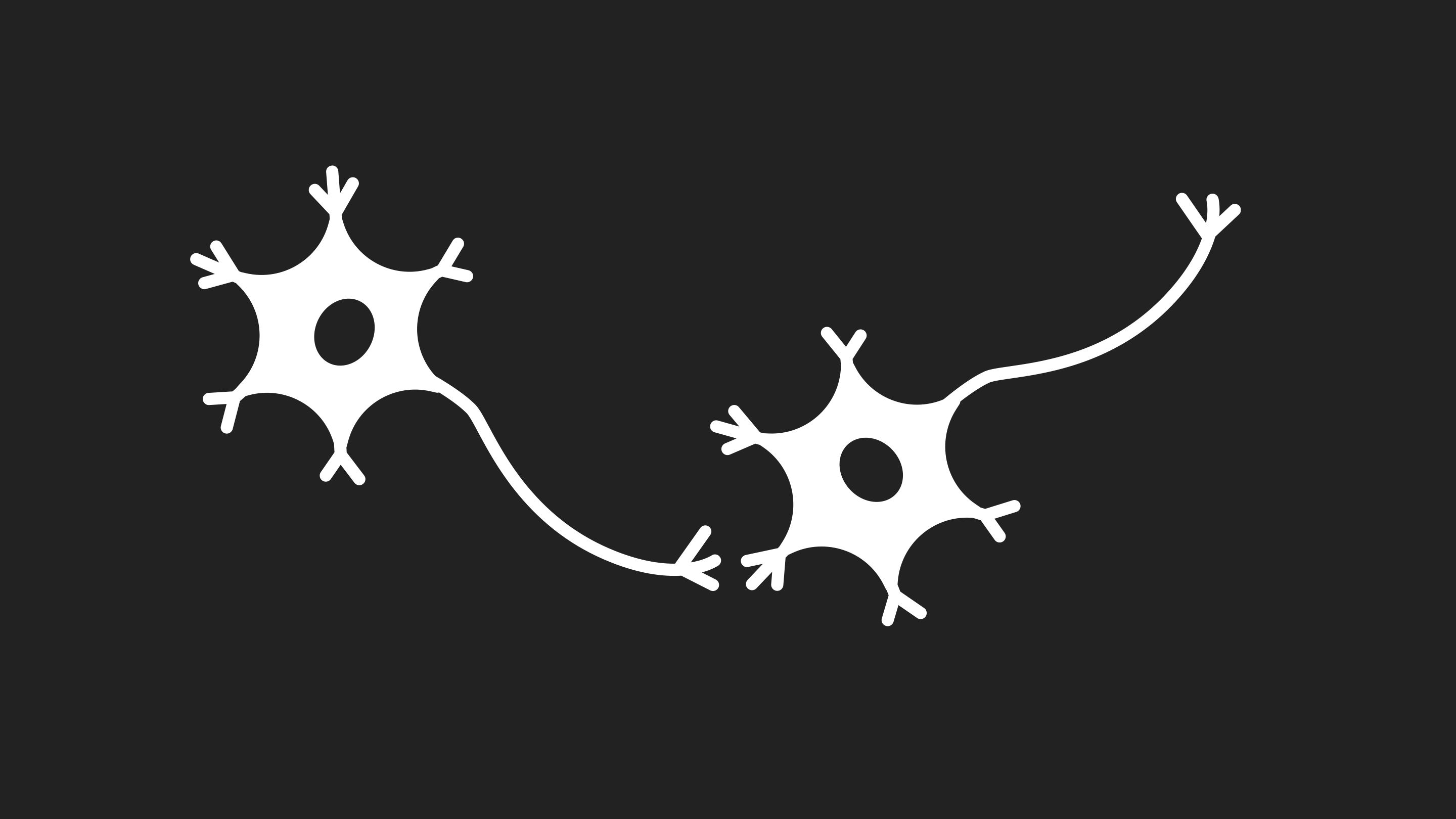
- Neurons pass electrical signal from one to another through connections.
- If one neuron gets enough electrical signal, it can activate or fire, triggering another electrical signal to pass on to another neuron through a chain of connected neurons.
- Just like we were inspired by the way humans learn to come up with reinforcement learning, we might also be inspired by the structure of the human brain to imagine what it would take to make an artificial, computerized neural network.
-
Instead of biological neurons, we have artificial neurons, which you can think of as just a unit that stores some value, like how a neuron stores electrical energy. These neurons are connected to each other, able to pass their values from one to the other.
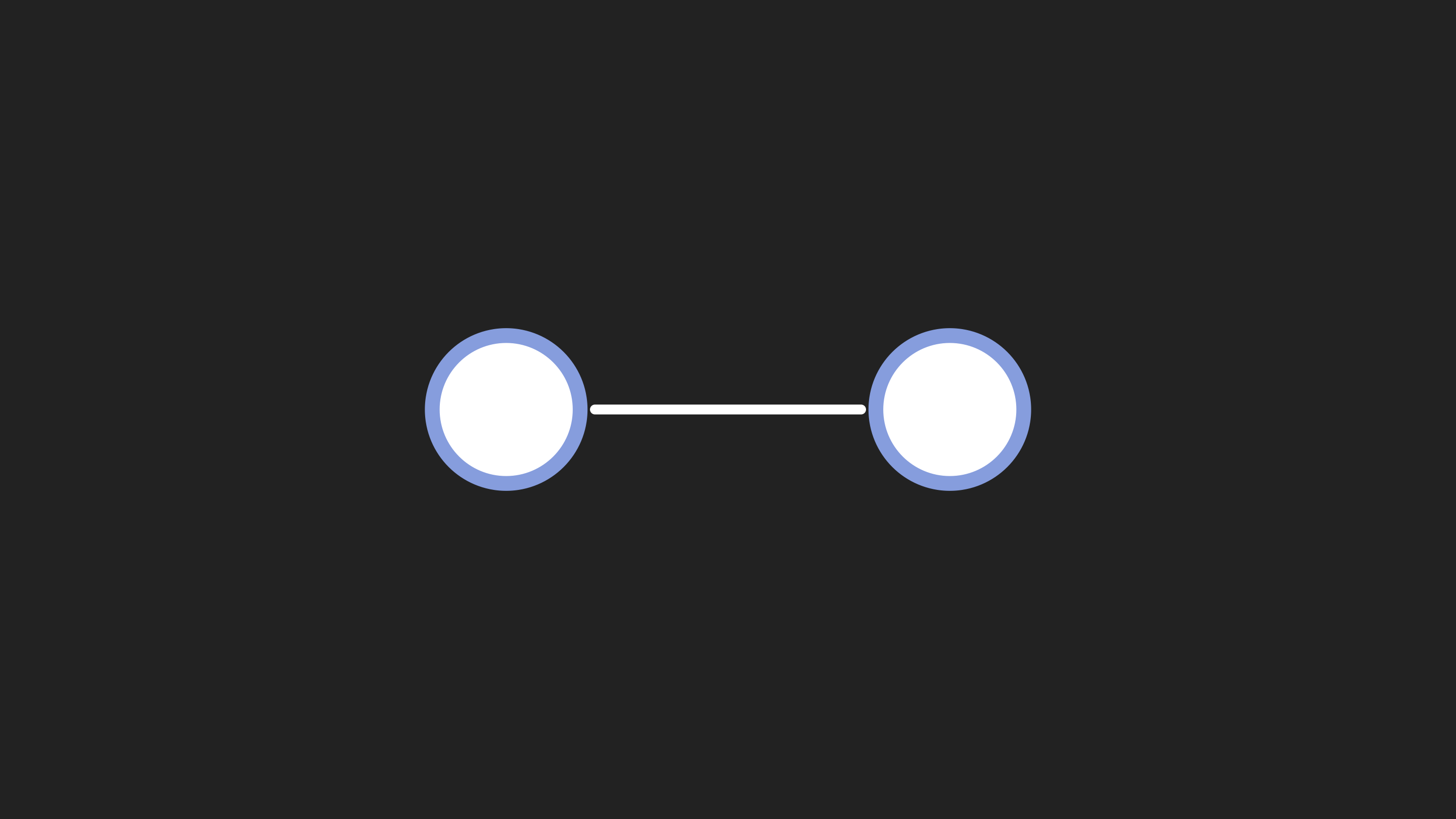
- What is a neural network actually doing? You can think of a neural network as essentially acting like a function. It takes input and produces output.
- Our neural network takes input values and tries to produce one value as output. What the neural network learns to do is transform these inputs into that output for almost any task we might imagine.
- There are a variety of things you might try to predict. Maybe you work in a business and want to predict what your sales will be based on advertising spend. Maybe you’re trying to predict whether it’s going to rain based on humidity and pressure.
Training Neural Networks
- If you just created a neural network and told it to predict whether it’s going to rain based on humidity and pressure, initially it would have no way of knowing what the right answer is.
- What we do with the neural network is train it with data. If you gave the computer data of many days in history, telling the computer on each day here was the humidity, here was the pressure, and this is whether or not it rained, then the computer can learn via this neural network architecture how to compute that output based on the inputs.
- What does that math actually look like? Each input has a value: we’ll call them X and Y. The neural network learns parameters, specific values the computer learns to work with.
- We learn one parameter, A, associated with the first input. We learn another parameter, B, associated with the second input. We also learn a third parameter, C, that’s not associated with any input: general information about likelihood.
- The neural network multiplies each input by its corresponding parameter, otherwise known as a weight. We multiply A by X and B by Y, add those together, then add parameter C, often called a bias. Then we perform a comparison: is this value at least zero? If yes, one category. If less than zero, another category.
- Depending on the values of A, B, and C, that determines what output we get for any input. That’s what a neural network learns: what numbers to use for A, B, and C that allow this equation to do a good job of predicting.
- Initially, these values start randomly. They won’t do a good job. But as we add data, we can learn from each additional data point. We try to predict, and make adjustments to the values to make predictions more accurate.
- That’s why companies building machine learning models care so much about having more data. The more data you have, the more you can refine what neural networks learn, doing a better job of making predictions.
- Every time we get a new piece of data, if we classify it wrong, we learn what adjustments to make to allow it to do a better job of classifying in the future.
-
As we deal with more complex data, this representation starts to look more complicated. Imagine we wanted to solve handwriting recognition. Here’s a handwritten digit in a 4-by-4 grid of pixels.
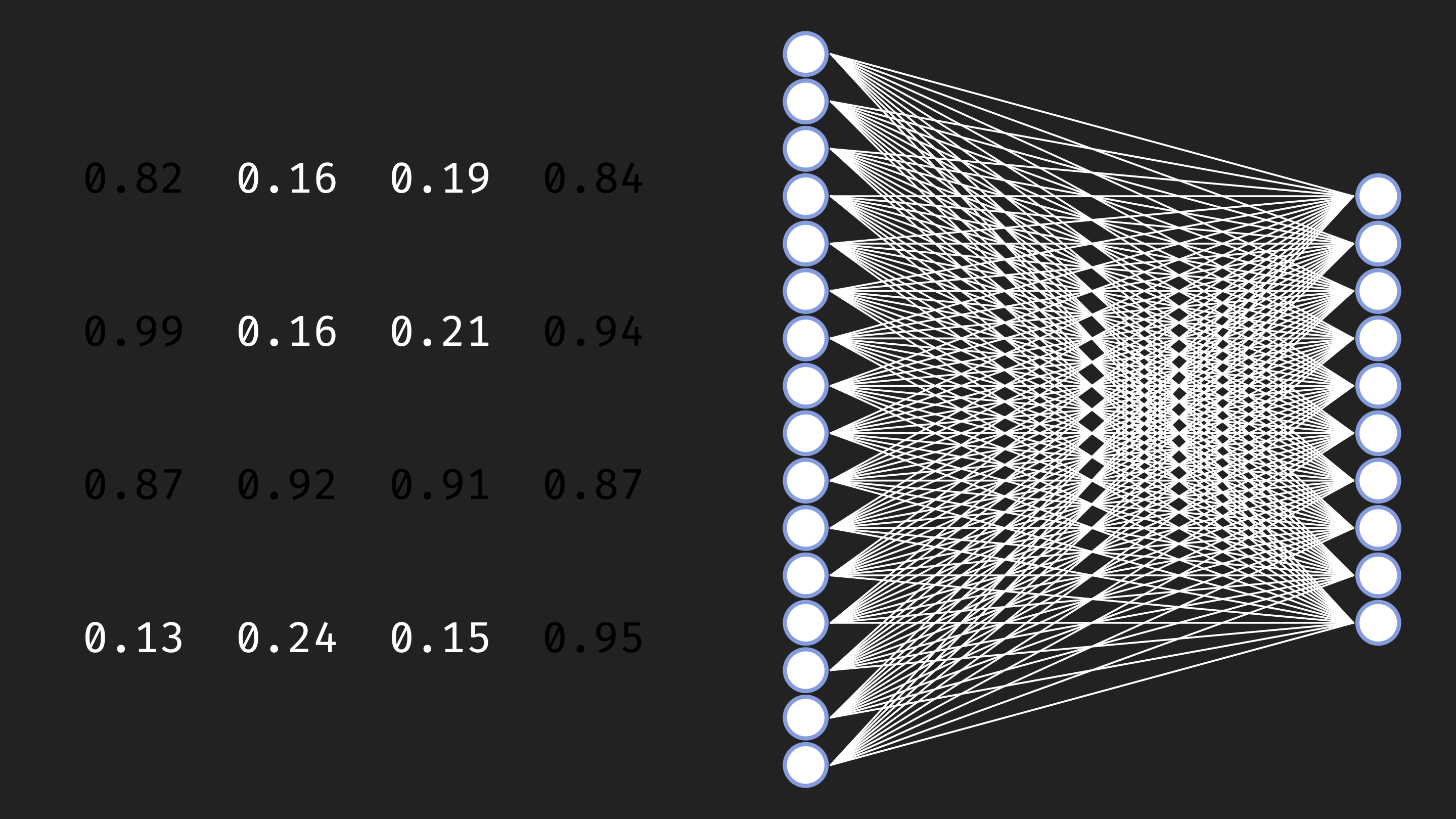
- Each pixel can be represented as a value describing how light or dark it is. How could a computer learn to classify this as the digit 4?
-
We construct a neural network with not 2 inputs but 16 inputs, one for each pixel value. If we’re classifying digits, we might have 10 outputs: is it a 0, 1, 2, 3, 4, 5, 6, 7, 8, or 9?
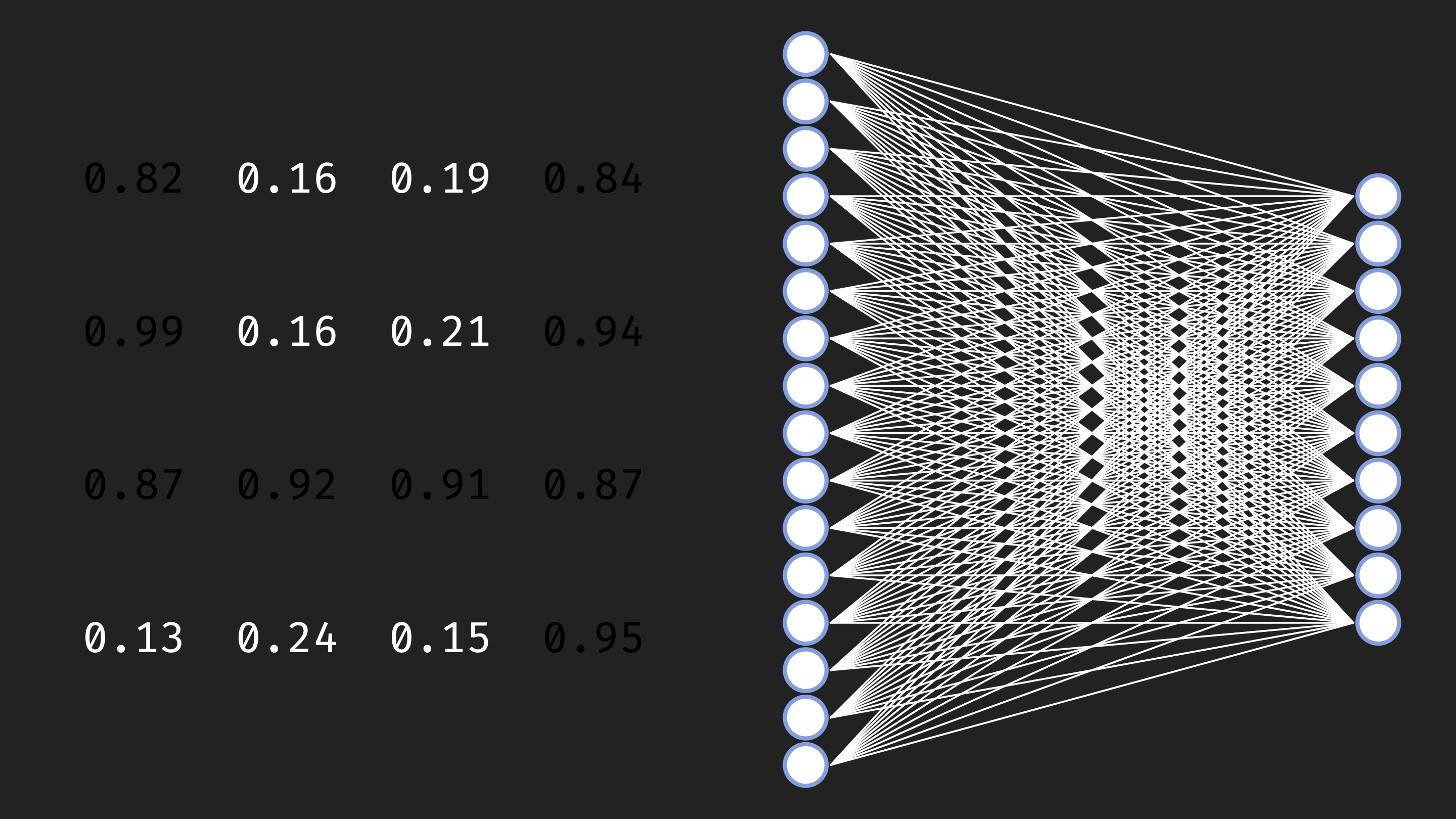
- When the neural network has many more parameters, it learns to take pixels as input and classify them.
- As we add larger data, we might make modifications to this architecture. Often neural networks have multiple different layers doing multiple kinds of transformations.
- But ultimately the idea is the same: the neural network learns a function that takes input (all the pixel data) and produces an output (a prediction). Initially it’s not good at this, but via training it learns what values to use for all these connections to predict effectively.
- This is similar for any classification task. Spam email classification also takes input data (an email) and tries to predict: is this spam or not?
Natural Language Processing
- To classify emails, we need some understanding of natural language. Getting the computer to work with natural language is complicated because language is inherently ambiguous. Words have multiple meanings. There are different ways of saying the same thing.
- If we want the computer to understand English, we need strategies for figuring out how a computer can do that.
- One of the first is figuring out how to take words and translate them into numbers. Remember that computers ultimately work with numbers. If we want the computer to understand words, we need some way to translate those words into numbers.
- One way would be to take every word and give it a number. The word “hello” could be number one. “Cat” could be number two. “Computer” could be number three.
- But it’s difficult to encode the entire meaning of a word in just a single number. A single number can only represent one thing.
Word Embeddings
- Instead of using a single value, we use what we call a distributed representation. Instead of representing a word with one value, we represent the word with multiple values.
-
Here we represent the word “hello” with five different numbers. In practice, it might be more than five. Every word is associated with a different sequence of numbers, a different vector of numbers. The word “cat” is associated with a different sequence of values, and “computer” with a different sequence as well.
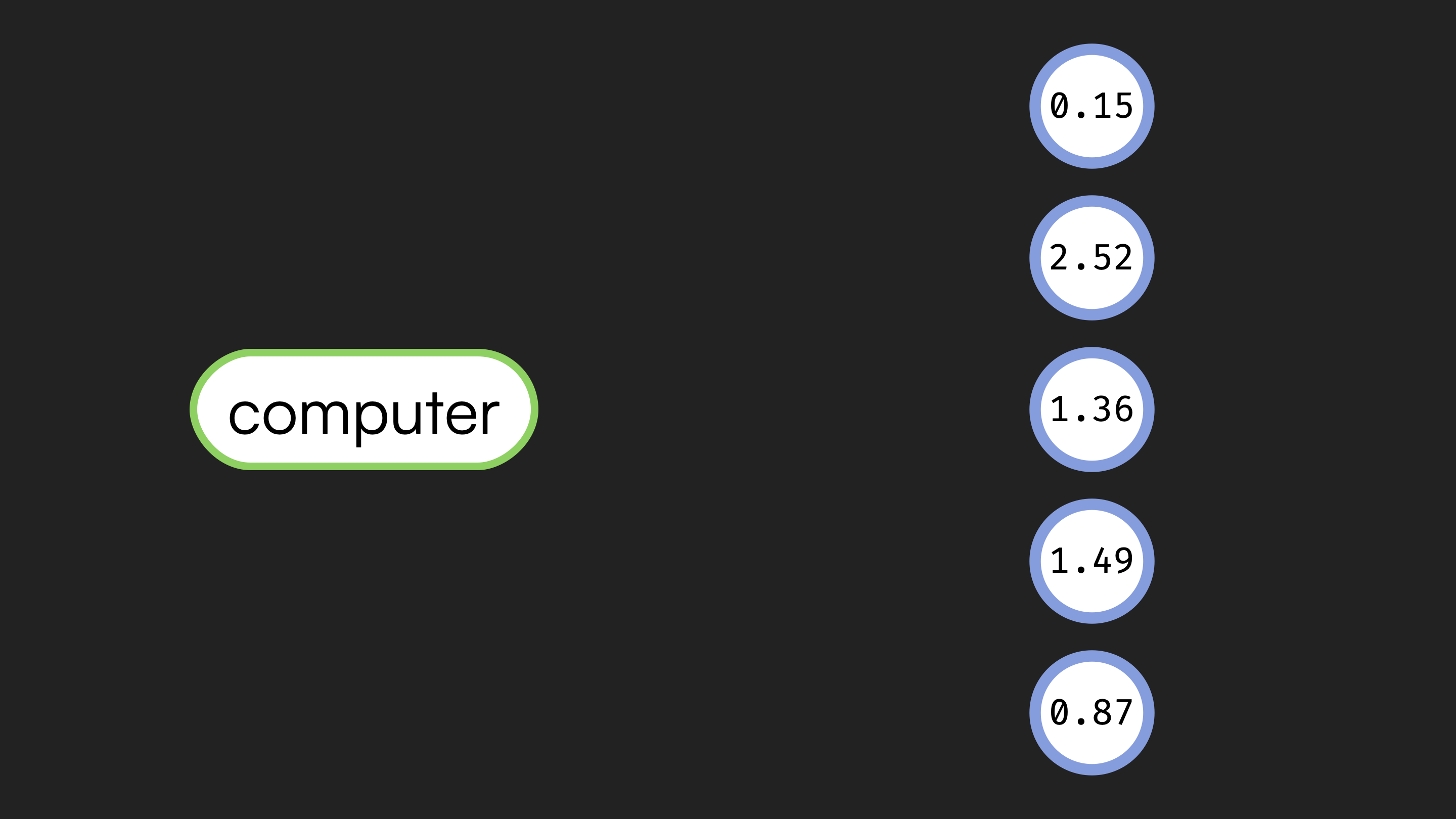
- In this case, the word is mapped to multiple numerical values.
- What do these numbers actually mean? Ultimately, they have meaning in relation to each other. On its own, one particular set of numbers doesn’t mean much, but it means something when you compare the meaning of that word with the numbers representing the meanings of all other words in your vocabulary.
- You can imagine plotting all of these representations, which we call embeddings. An embedding is the numeric representation for the meaning of a word. We could plot all those embeddings on a graph.
-
What we hope to find is that words with similar meanings end up being located in similar places when we plot their embedding values.
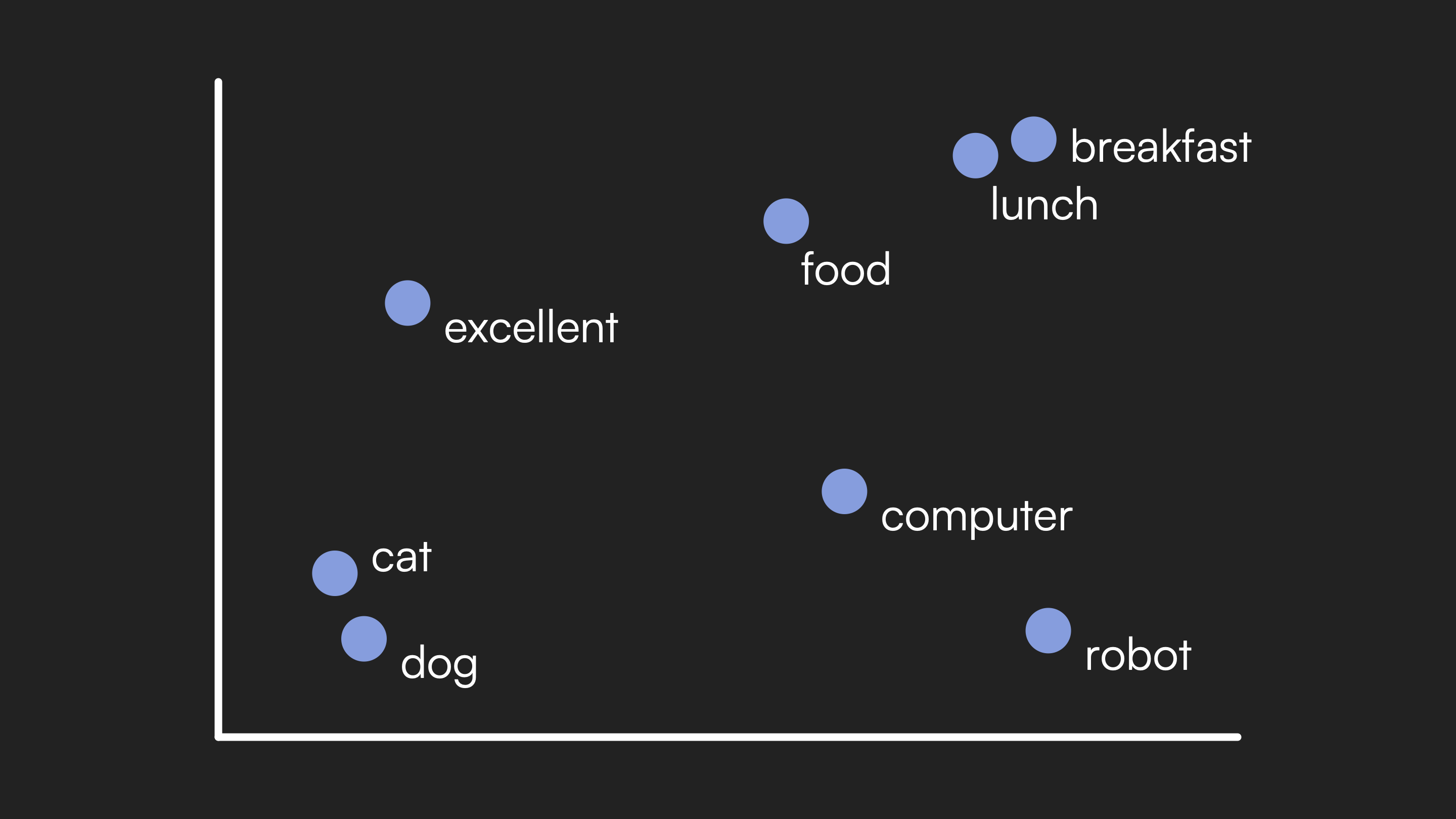
- “Cat” and “dog” cluster together, and “breakfast” and “lunch” cluster together, while they’re far from each other.
- “Cat” and “dog” are similar words, so they should have embeddings that are reasonably close to each other, definitely different from “breakfast” and “lunch.”
- How does a computer know that two words have similar meaning? One way is based on the context in which a word appears. The idea is that if a word shows up in a similar context to other words, those words probably have a similar meaning.
- For example: “For blank, she ate.” We could fill in “breakfast,” “lunch,” or “dinner.” Because these words can all appear in a similar context, we might conclude they have similar meanings.
- Whereas “for excellent, she ate” doesn’t make sense. That tells us “excellent” has a very different meaning than words like “breakfast” and “lunch.”
- If you give a computer a large amount of training data, a whole bunch of text, the computer can learn what words tend to appear in what contexts and use that to figure out what words have similar meanings.
Attention and Transformers
- Using this approach, we can assign each word an embedding, a sequence of values representing the meaning of that word, and use that as input to a neural network that processes language.
- But to do that well, the meaning of a word often depends on the words that appear around it. Knowing what word comes next in a sequence depends on understanding not just an individual word, but how those words relate to each other.
- Imagine we were trying to predict the next word in a sequence. This is exactly what large language models are doing. You ask a large language model a question, and it predicts the first word of the answer, then uses that to predict the second word, then the third, one word at a time, generating what it thinks the likely response is.
- Given a sequence of words, how would you predict what comes next? You would focus on particular words in the sequence that are helpful for making that prediction.
- Consider a passage from Alice’s Adventures in Wonderland. To predict the next word, you might notice the word immediately before is “golden.” You might notice other clues: something she tried, a door involved, some locks. Earlier, another reference to “golden” described a “key.”
- All those clues allow you to reach the correct conclusion that the next word is “key.”
-
How did you figure that out? By understanding the passage in context, and by paying attention to clues that allowed you to figure out the next word. Not every word was useful, but some words were useful, and you paid attention to those.
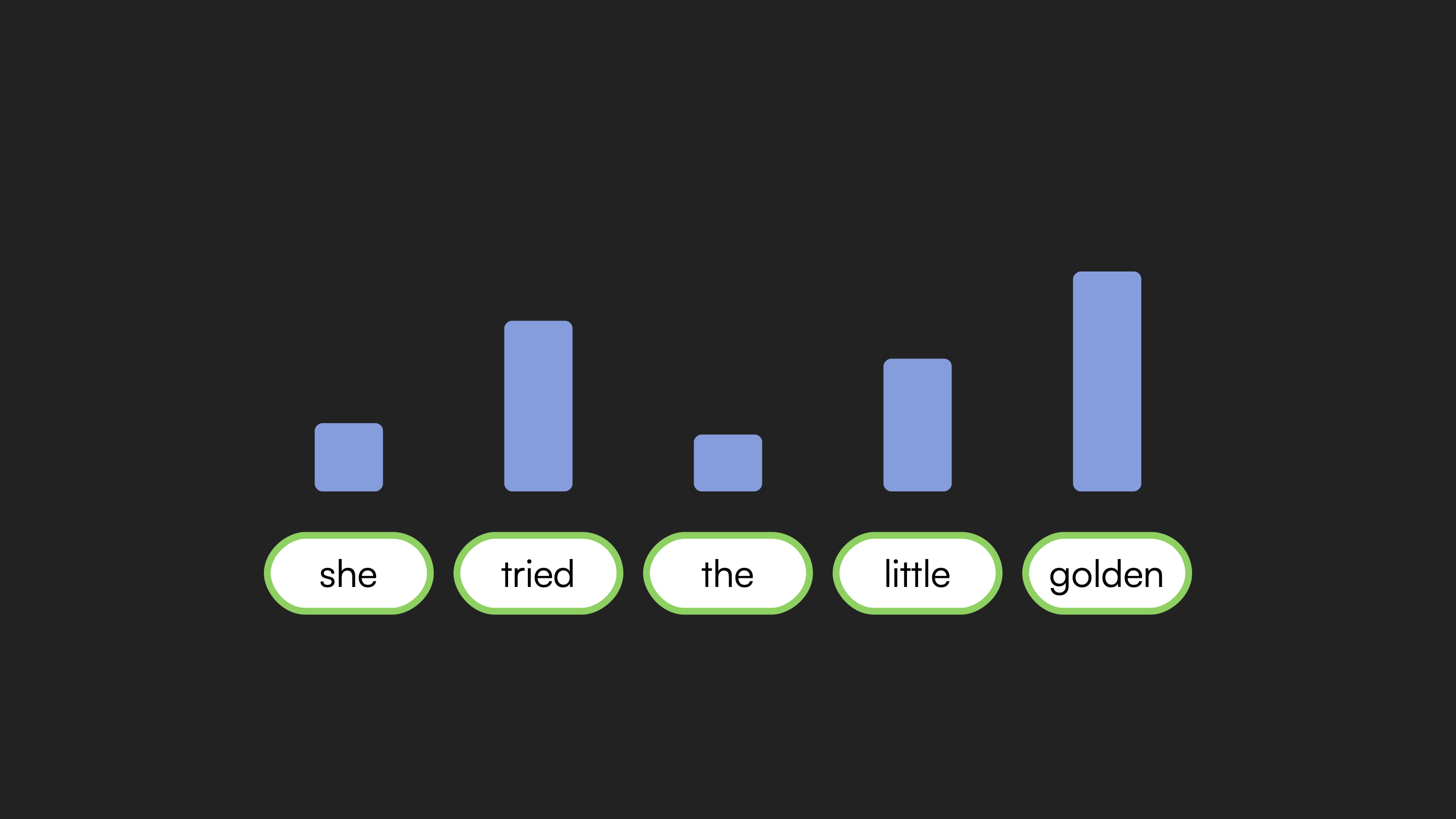
- Different words receive different levels of attention based on their relevance to prediction.
- One of the key innovations in natural language processing is building attention into computer models too.
- One of the most popular architectures nowadays is the transformer architecture. The transformer architecture is built upon this idea of attention. To predict the next word in a sequence, we allow the meanings of words to be updated based on other words in the sequence by paying attention to words that are particularly relevant.
- Given a sequence of words, a transformer architecture will look at the sequence and calculate what words should we be paying attention to. We calculate an attention score for each word that came before in order to figure out what to pay attention to, increasing the likelihood of predicting the next word.
- When you give a transformer architecture, a large language model, a whole bunch of training data, what is it learning? It’s learning how to do this attention process, how to figure out what words to pay attention to in order to give it the best chance of predicting the next word.
- We train it like our other neural networks: when we predict a word correctly, we learn from that. When we get it wrong, we figure out how to adjust the weights, adjust the parameters to do a better job in the future.
Summing Up
In this lesson, you learned the fundamentals of artificial intelligence. Specifically, you learned…
- About artificial intelligence and its wide variety of use cases, including game playing, handwriting recognition, spam classification, recommendation systems, and text generation.
- How games offer simplified environments for AI research with fixed rules and clear constraints.
- About decision trees as a way to structure decision-making by asking questions and making decisions based on the answers.
- How the Minimax algorithm assigns numerical values to game states and allows computers to play games optimally by maximizing or minimizing those values.
- About depth-limited search as a way to handle complex games like chess where exploring all possibilities is impractical.
- How evaluation functions predict the value of game states when we cannot calculate to the end of the game.
- About reinforcement learning, where computers learn from experience through trial and error.
- About the balance between exploring new possibilities and exploiting existing knowledge.
- How neural networks are inspired by the human brain and learn to transform inputs into outputs through training.
- About word embeddings as distributed representations that capture the meaning of words in relation to each other.
- How attention and transformer architectures allow computers to understand language by focusing on the most relevant words when making predictions.
See you next time!